Important Questions When Searching For A Horse Boarding Facility – Part 2
In my last post I talked about my ordeal finding a new horse boarding facility. I thought the questions I asked might be helpful.
You can download the top 20 questions that were most important to me.
The obvious questions:
- What type of board do you offer and what are the rates for each? There are a number of possibilities – full service stall or pasture, self-service stall or pasture, pasture only, etc.
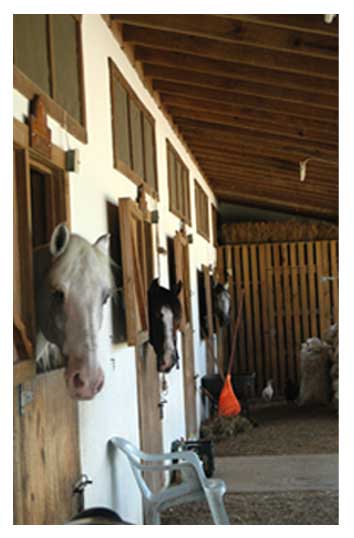
- If you want a stall for your horse, how big are the stalls? Most stalls are either 10’x10’ or 12’x12’. The size of the stall should match the size of your horse. A pony or small horse will do fine in the smaller stall, but a larger horse (say over 15h) would be better off in the larger stall.
- How long are the stalled horses allowed outside each day? Every horse needs some time outside either in a run, paddock or pasture. Horses need daily exercise and they should be allowed to free graze for a few hours each day. This makes for a healthier, happier horse.
- How many horses are turned out on each pasture? You want to make sure
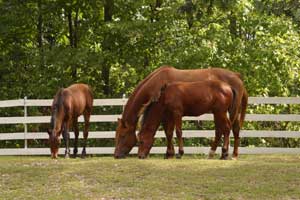 that the pastures are not over grazed. Depending on the condition of the pasture, a lush green pasture could support 1 horse per 1½ – 2 acres. If there are more, the pasture should be supplemented with hay.
 - Are the horses pastured according to gender? Some barns will have their pastures designated as mare or gelding pastures.
- What type of grain and hay are used? If the feed is not the same as you use, bring enough feed for your horse for a minimum of 1 week of feedings. This can be mixed with the new feed and transition your horse slowly to the new feed.
- If your horse is on a special diet, does the facility provide that feed? If not, will they provide it and charge you the difference between the different feeds? If you have to provide your own special feed, will the facility give you a discount on your board bill?
- How many times a day do you feed? Some boarding facilities feed twice a day, some feed only once a day, but I have heard of others that feed 3 or 4 times a day. What ever it is, know the feeding schedule and what is being fed at each one. Discuss any changes that your horse may need with the owner or manager.
- What vaccinations or medical records are required to move in? The most important and common health paper required is a negative Coggins. You also may be required to provide a health certificate.
- Is there an arena and what type is it (indoor or outdoor)? Arenas are a big plus for me.
- Is there a round pen? This gives you a small area to do concentrated training without worrying about being in the way of others in a large arena. It is also great for lunging your horse or groundwork.
- Is there a tack room? It is nice to have a place to put your tack and grooming supplies on the premises. I have come across a few places that did not offer a tack room.
Some not so obvious questions:
- What hours/days is the boarding facility open? I’ve found a facility that was closed on Sundays and I’ve found one that as only open from 8 am to 8 pm. Both assured me that the facility was open if there was a sick or injured horse that needed medical attention. Make sure you know the hours of operation.
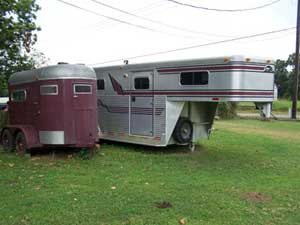
- Are there extra fees for services rendered by the staff? This is an important question that is often missed. Make sure you know what each fee is because they can add up in a hurry and make your reasonable monthly board bill prohibitive. An example of what extra fees could be are for trailer parking, holding your horse for the farrier/vet in your absence, putting on/removing blankets or adding the supplements you provide for your horse.
- Is there a wash rack? If there is a wash rack, find out if it is indoors or if it has hot and cold water. If not, they may have a specific place where you are permitted to wash your horse.
- Does the gate need an access code to open? Not all facilities have this. If you decide on a facility that does, make sure you get the code.
- Does the facility have a resident vet or farrier? Some facilities like to use one vet or farrier and have all work done by their chosen professionals. There is an advantage to this as it may reduce the cost of vet farm calls or get a group rate from the farrier. You should be able to use your own vet or farrier at any facility, but make sure by asking before you move in.
- Does the facility have a regular vaccination program? This means that the facility sets up an appointment with the resident vet to vaccinate all of the horses, pull a Coggins, float teeth etc. at the same time.
- Does the facility schedule trimming/shoeing with its resident farrier? The stable I’m at now schedules all horses in 2 visits with its own farrier. This can help keep the cost down.
- Is there training/lessons available? If not, ask if bringing your own trainer/instructor is permissible.
- Are there accessible bathrooms? This may seem like an odd question, but I looked at a couple of facilities that did not offer bathrooms to the boarders. This could be problematic if you have children or you just had too much coffee before going to ride.
There could be questions that you may not even know to ask of the facility or your vet/farrier:
- If the facility owner is the only one doing the work, how are the horses taken care of when the owner is sick or on vacation? This may only be a problem with the smaller boarding facilities that do not employ additional help. Even with the larger facilities, ask who will be taking care of your horses.
- Can a friend bring their horse to ride with you in arena or trails? Not all boarding facilities will allow non-boarding horses on the property for health reasons. There are some very contagious illness that can sweep rapidly sweep through a barn. I have seen a few boarding facilities that have riding memberships available. There is a small fee per ride or per month and a yearly current Coggins must be on file with the facility office.
- Are the arenas, wash racks, tack rooms etc available to all boarders? I’ve
 heard of some facilities that only allow the full service stall boarders use indoor arenas etc. If you are on a lesser board option, make sure you know what you get to use.
 - Will your vet go to this facility? You can call your vet’s office to find out if there will be any change in the farm call fee.
- Will your farrier go to this facility? Ask your farrier if he will travel to the new facility. If so, you need to ask if his rates will change.
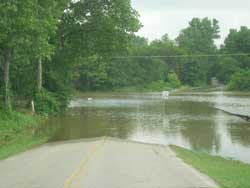
- Is there an emergency plan in case of fire, flood, etc? This is a question most people don’t even think about until some act of nature hits them. Whatever the cause, you need to know if there is action plan if your horses need to evacuate from the boarding facility.
You may have other questions that pertain to your particular needs. If you do, write them down or add them to the list I provided so you don’t forget to ask them when you visit a horse boarding facility.
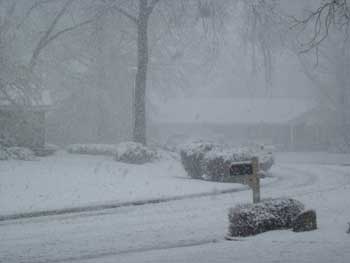 It’s the last weekend of March. Mother Nature has teased us more than once with beautiful springtime weather. This weekend did not qualify for that in Oklahoma. We have had one doozy of an early spring snow. In my area, that has been 4″-6″ of the white stuff. The farther west you live has turned into as much as 26″-28″ of snow. I know, some of you from the north are saying “Waaaaa, whiners”.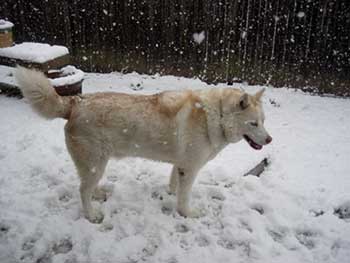
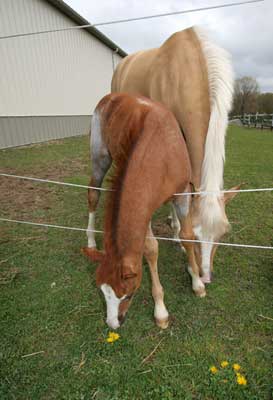 accompany each vet on calls and the barn manager who looks after your horse if he needs to stay for more intensive care. I really appreciate each & every one of these people. They do a great job. A presentation was done by each of the 2 new vets. One was on the importance of proper wound care. I could go on for days about this subject because my horses have given me plenty of practice. But I would like to talk about how you can possibly prevent some injuries.
 looked for hours & did not find a spot of blood or the tell tale sign of horse hair on a fence post or tree branch. Zip’s injuries were costly & required weeks of stall rest to heal.
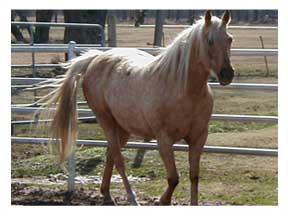 The floundering economy has touched the horse industry in so many ways. My own personal concession is I had to sell one of my horses. I did this last November (before Iggette passed) to try to cut the rising cost of my board bill as well as the vet bill. I didn’t want to sell Princess (pictured) and it was a hard decsison to make. Actually I was supposed to sell one when I purchased my gelding over 2 years ago. I just didn’t ever get around to it. Quite honestly if we lived on our acreage instead of in town, I wouldn’t have sold her. But she has a very nice owner who decided to stay at the barn where I am, so I get to see her all the time. After Iggette passed away, I was left with 2 horses. Even with my board bill being reduced by 2 horses, the money crunch can still be felt. I have made some small adjustments in my horse keeping to save some money. Here are a few of the ways that I chosen to save money. Please keep in mind that my choices may not work for you. Make your decisions wisely.